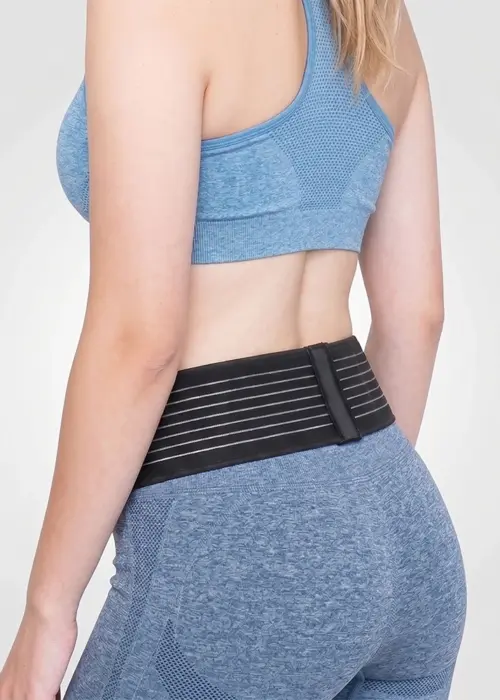

SI joint compression technology applies steady, targeted pressure across the sacroiliac joint to reduce excess movement between your pelvis and spine. Less movement typically means less inflammation, less muscle strain, and better posture through a normal day. The Cyson SI Joint Belt is built around this principle — offering a practical, drug-free way to manage SI joint pain.
A lot of people don’t know their sacroiliac (SI) joint exists until it starts causing problems. Once it does, the discomfort has a way of spreading — into the hip, down the leg, across the lower back — and it rarely behaves in a way that’s easy to pin down. If you’ve had an ache in that area that just shifts around and never fully resolves, the SI joint is worth understanding.
What follows is a straightforward look at what this joint actually does, how compression technology supports it, and who tends to get the most out of using it.
What Is an SI Joint? Understanding Your Sacroiliac Joint
Your SI joint links the sacrum — the flat, triangular bone at the bottom of your spine — to your pelvis on each side. Most people have never noticed the two small dimples on either side of their lower back, but that’s roughly where these joints sit.
Unlike your knee or hip, the SI joint isn’t built for movement. It’s a stability joint. Its job is to transfer load between your upper body and legs, absorb impact when you walk or run, and hold the pelvic structure together under constant mechanical stress. When it’s doing its job, you don’t notice it at all.
When something disrupts that stability — an injury, pregnancy, years of repetitive strain — the joint can start moving more than it should. The pain that follows often travels down into the hip or along the back of the leg, which is why SI joint instability gets mistaken for sciatica so often and goes undiagnosed longer than it should.
SI Joint Compression Technology in Action: How It Works
The logic behind SI joint compression technology is fairly intuitive once you hear it. You apply firm, even pressure around the outside of the pelvis to reduce uncontrolled movement at the joint. A loose door hinge is a decent analogy — you can still open the door, but you’re stopping the rattle.
The Cyson SI Joint Belt works on that same principle. It wraps around the pelvis just below the hip bones, with adjustable straps that maintain consistent compression through daily activity. The point isn’t to lock you in place. It’s to remove the excess, uncontrolled motion at the SI joint that turns ordinary movements — getting out of a car, climbing stairs, standing up from a chair — into something genuinely uncomfortable.
How SI Joint Compression Can Help: Key Benefits
People who use compression support consistently tend to report a few common improvements:
- Limits unwanted movement — Even pressure keeps the joint within a normal range, so routine activity doesn’t keep triggering irritation. Walking and standing feel more stable with less effort.
- Pain reduction — Less motion at the joint means less friction and nerve irritation in the surrounding tissue. Many users of the Cyson SI Joint Belt report a real drop in daily discomfort within the first week.
- Muscle relief — When the SI joint is unstable, your lower back and hip muscles end up compensating — often to the point of becoming sore themselves. Compression takes some of that burden off, giving those muscles a chance to recover instead of just grinding through it.
- Better spinal alignment — A stabilized pelvis makes it easier to maintain a neutral spine across a full day of sitting, standing, and moving. That cuts down on the cumulative strain that leaves your lower back aching by mid-afternoon.
The Science Behind SI Joint Compression Technology and Pain Relief
In biomechanics, the relevant concept here is “form closure” — the idea that external pressure can compensate for a joint’s internal stability structures when those structures have been compromised. Your SI joint normally depends on a combination of ligaments, surrounding muscles, and surface friction to stay in place. External compression steps in when that system isn’t holding on its own.
Pregnancy is probably the clearest illustration of this. The hormone relaxin loosens ligaments throughout the body to prepare for childbirth — which is necessary, but it often makes the pelvis feel unstable well before that becomes useful. A compression belt effectively replaces some of that lost ligament tension, letting women stay active and on their feet instead of being limited by pelvic discomfort.
Athletes face a different version of the same problem. High-load, repetitive activity — distance running, heavy lifting, agility training — chips away at the SI joint’s natural stability over time. Wearing compression support during training can reduce that cumulative stress enough to keep athletes consistent rather than cycling in and out of flare-ups.
For people dealing with chronic back pain, SI joint instability is an often-overlooked factor. Because the symptoms overlap so much with disc and muscular pain, it gets treated incorrectly for months. Trying a compression belt is a low-cost, low-risk way to test the hypothesis — if symptoms improve with compression, that’s a useful signal worth following up on with a specialist.
Everyday Benefits of SI Joint Compression Support
Beyond clinical use, there are some very practical, everyday reasons people reach for SI joint compression support:
- Sitting for long stretches — Long days at a desk or extended travel tend to leave the SI joint stiff and irritated. Wearing compression support during those hours can noticeably reduce the discomfort that accumulates by late afternoon.
- Staying active during pregnancy — As the centre of gravity shifts in the second and third trimesters, a compression belt provides enough pelvic support to keep expecting mothers walking, working, and moving the way they want to.
- Athletes returning from minor SI joint injuries — use a compression belt as part of a gradual return to training — wearing it during harder sessions and leaving it off for easy recovery days as the joint settles.
- Managing bad days with chronic pain — For anyone living with ongoing lower back pain, having a reliable compression belt on hand for high-symptom days offers something immediate that doesn’t require medication or a clinic appointment.
One thing worth saying directly: a belt is a support tool, not a cure. It works best as part of a broader approach that includes physical therapy, appropriate strengthening work, or guidance from a musculoskeletal specialist.
Finding the Right SI Joint Compression Belt for Your Needs
Understanding how SI joint compression technology works makes it easier to choose the right product. Fit genuinely matters here. A compression belt that sits in the wrong position on your pelvis, or doesn’t distribute pressure evenly, won’t give you the results a well-fitted one can.
If you’re ready to explore your options, check out the Cyson SI Joint Belt and the full range of back support solutions at www.Cyson.in.