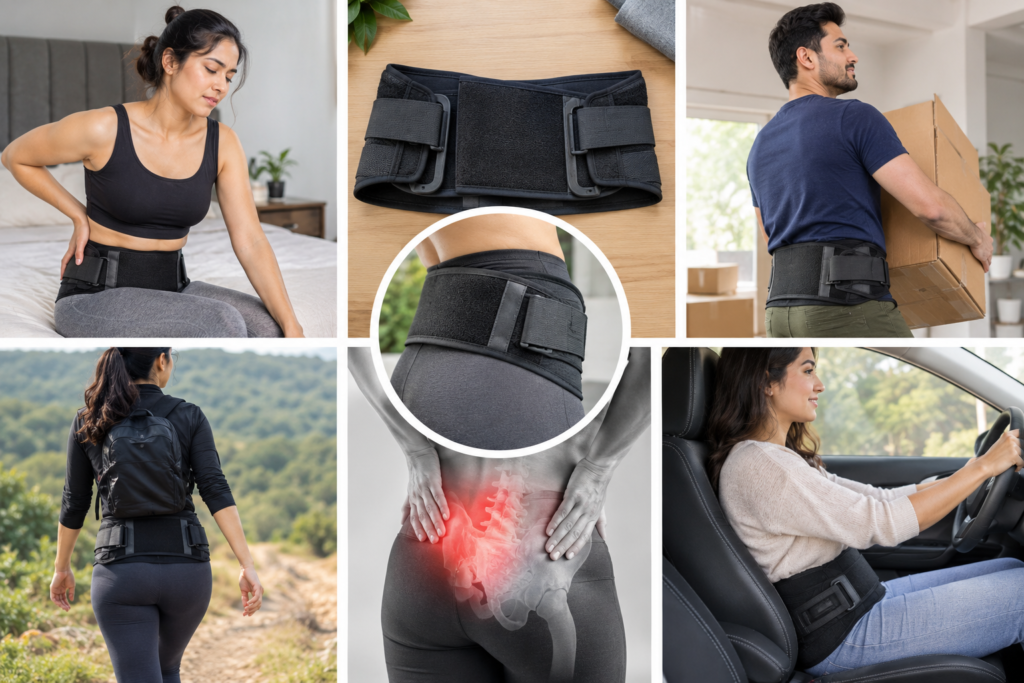

The SI Joint Belt supports the sacroiliac joint — where your spine meets your pelvis — by applying targeted compression that reduces pain and helps you move more comfortably. It’s a non-invasive, drug-free option for office workers, postpartum women, athletes, and anyone dealing with stubborn lower back pain that won’t respond to the usual fixes.
Here’s something most people don’t expect: the source of their lower back pain isn’t always what they think it is. It’s not always a disc. It’s not always a pulled muscle. A lot of the time, it traces back to the sacroiliac (SI) joint — a joint that barely gets mentioned outside of physical therapy offices, even though it’s doing serious work every time you stand, walk, or lift anything heavier than a bag of groceries.
If you’ve been managing lower back pain for a while without much progress, the SI joint might be where you should be looking. And the SI Joint Belt is one of the more straightforward tools for addressing it.
What Is the SI Joint, and Why Does It Cause Lower Back Pain?
Your sacroiliac joint is the place where your sacrum (the triangular bone at the bottom of your spine) connects to your iliac bones. It’s the bridge between your upper body and your legs, and it absorbs force on every step you take.
When that joint gets inflamed, injured, or just plain loose, things start to go wrong in ways that aren’t always obvious. Pain can show up in your hips, your groin, even your upper thighs. Your body quietly adjusts how you walk to compensate, which then creates a new set of problems in your hips, knees, and lower back muscles. What looked like a hamstring issue or a tight hip flexor might have been the SI joint all along.
Key Benefits of the SI Joint Belt for Lower Back Pain
1. Pain Relief With the SI Joint Belt
The belt applies focused compression to the hips, lower back, and pelvis — the area directly around the SI joint. That pressure helps calm inflammation and can take the edge off the dull, persistent ache that makes ordinary things feel harder than they should. A lot of people notice a difference within an hour of putting it on, not after weeks of waiting.
2. Stability Support From the SI Joint Belt
When the SI joint is unstable, the surrounding muscles pick up the slack — and they weren’t built for that. The belt adds external support to that region, so your body isn’t constantly fighting to hold itself together. Getting up from a chair, walking with a bag, climbing stairs, those motions don’t bring the familiar ache anymore.
3. Posture and Alignment Improvement With the SI Joint Belt
Support the SI joint properly, and your spine and pelvis can settle into a more natural position. That takes load off nearby muscles — the piriformis, the hip flexors — that tend to tighten up when the joint isn’t stable. Less tension there means less fatigue by the end of the day.
4. All-Day Wearability With the SI Joint Belt
It’s thin enough to wear under clothes without bulk, and comfortable enough to forget you’re wearing it. New mothers working through postpartum recovery, athletes in heavy training blocks, and workers who spend full shifts on their feet tend to get the most out of wearing it consistently throughout the day rather than only when the pain spikes.
5. Non-Invasive, Drug-Free Relief With the SI Joint Belt
Surgery means downtime. Medication carries its own risks over the long term. An SI Joint Belt is a reasonable first step — something you can try without committing to anything invasive, and something that works alongside other treatment if you’re already seeing a physio or chiropractor.
How the SI Joint Belt Is Built for Comfort
The Cyson SI Joint Belt uses breathable material that holds up through a full day without trapping heat or becoming uncomfortable. Adjustable straps let you increase or reduce the compression depending on what your day looks like — more support on training days, lighter pressure when you just need baseline stability.
What makes it different from a standard back brace is the specificity. Most braces wrap broadly around the lower spine. This belt targets the SI joint directly, which means your range of motion elsewhere stays largely intact. The anti-slip construction keeps it in place through sitting, bending, and walking, so you’re not constantly pulling it back into position.
Who Gets the Most From the SI Joint Belt?
- Office workers who sit for long stretches often don’t realize their pelvic alignment is shifting until the back pain has already built up. Wearing the belt during the workday can interrupt that pattern before it gets worse.
- Postpartum women deal with lingering joint instability long after delivery — the hormone relaxin loosens joints during pregnancy, and the SI joint can stay unstable for months afterward. Compression during that recovery period can make a real difference in daily comfort.
- Athletes in rotational or impact sports — sprinting, tennis, golf — put repetitive load through the SI joint in ways that accumulate fast. The belt is useful both during and between training sessions.
- Manual laborers who spend shifts bending, lifting, and carrying often experience slow-building pelvic and lower back strain that shows up as end-of-day exhaustion. Consistent support throughout the shift can reduce that load.
- Older adults managing joint degeneration often benefit most from non-invasive options before moving toward medication or more significant interventions.
Why the SI Joint Belt Is Worth It for Lower Back Health
If chronic lower back pain around the sacroiliac joint is affecting your sleep, your work, or just your ability to get through the day without thinking about your back every hour — the SI Joint Belt is worth trying. It won’t fix everything on its own, but it gives the joint the support it needs to stop being the thing that’s making everything else harder.
Visit www.cyson.in to learn more about the Cyson SI Joint Belt and other support products built to help you move with less pain